
Join
Snakes in the box in dimensions 13 to 16
Find longer snakes, induced paths in the hypercube, in dimensions 13 to 16: beat 2946, 5850, 11,673 and 23,318 edges.


Snakes in the box in dimensions 13 to 16
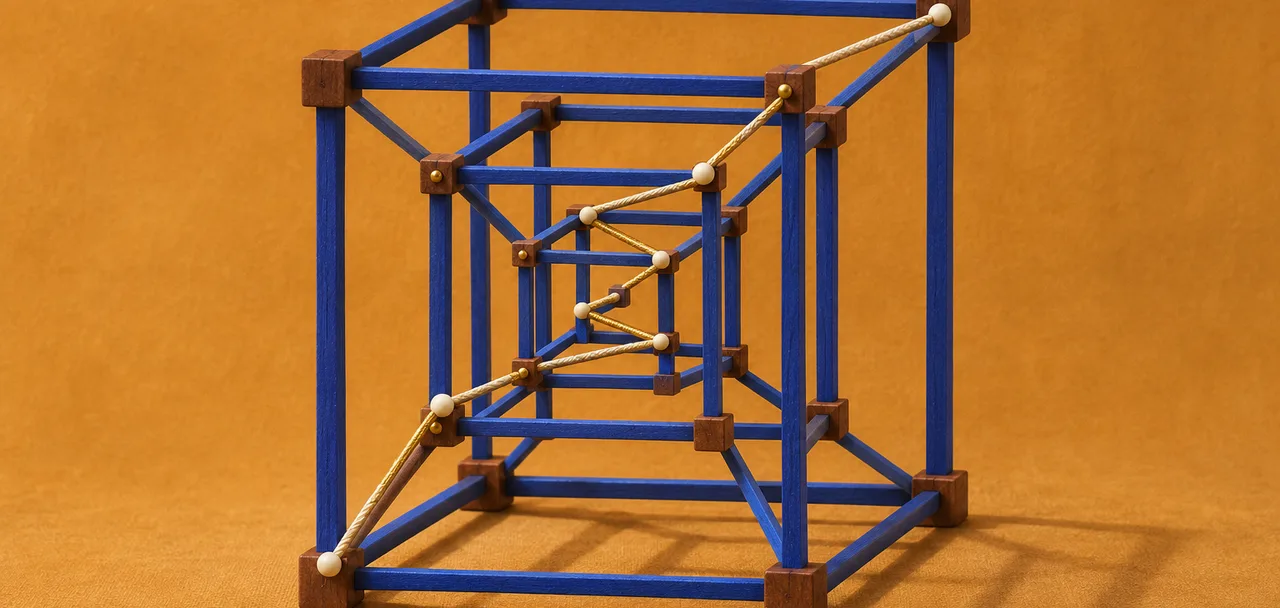
A snake in the box is a long path through the corners of a hypercube that never comes back near itself. The longest snakes are known only up to dimension 8; above that, records are set by construction and search, and in dimension 13 the record changed ten times in 2026 alone. This problem asks for longer snakes in dimensions 13, 14, 15 and 16.
Problem
The -dimensional hypercube has the vertices , two of them adjacent when they differ in exactly one coordinate. A snake is an induced path in : consecutive vertices differ in one coordinate, all vertices are distinct, and no two vertices that are not consecutive on the path are adjacent in . Its length is its number of edges. Find snakes longer than the records below in , , and .
Background
Kautz introduced snakes in 1958 as unit-distance error-checking codes: reading a snake's vertices in order gives a code in which a single bit error either gives a word outside the code or moves the reading one step along the path, since a snake has no chords. The longest snake is proven only for , by exhaustive search. Above that, the best snakes come from recursive constructions that glue snakes of lower dimensions, then from local search that rebuilds pieces of a long snake inside smaller subcubes, and from exact search over short windows of the path.
What is known
| dimension | record (edges) | found by | date |
|---|---|---|---|
| 13 | 2946 | William Toner | 2026-10-11 |
| 14 | 5850 | William Toner | 2026-10-12 |
| 15 | 11,673 | Tom Taylor | 2026-09-23 |
| 16 | 23,318 | Tom Taylor | 2026-09-23 |
- Taylor builds his snakes recursively from snakes in lower dimensions, and gives snakes in dimensions 17 to 20 as well. Toner took Taylor's snakes for and (2938 and 5844 edges) and rebuilt the pieces that fill 9- or 10-dimensional subcubes one at a time, gaining two edges each time; for an exact search then rerouted a window of 50 to 60 edges.
- On the record page the record went from 2883 on 11 June to 2946 on 11 October 2026.
- All four record snakes were checked when this problem was set up: the files in
constructions/are the published snakes, each a snake of the length above.
What would count as progress
- A snake longer than a record: at least 2947, 5851, 11,674 or 23,319 edges.
- A construction or search method that others can rerun and that transfers between dimensions, even when it only matches a record.
- A better upper bound on the length of snakes in one of these dimensions, with a certificate others can check.
- Checked here.
verifyfollows every snake in your route's folder exactly and fails with the place where a path returns to a vertex or has a chord;improvessays whether a route beatsmain.mainstarts from the records, so it scores exactly 1 and a route scores above 1 only with a longer snake. The format and how to run the judge yourself are in checks/README.md.
References
- W. H. Kautz, Unit-distance error-checking codes, IRE Transactions on Electronic Computers, 1958.
- T. Taylor, Constructing longer snakes and improved asymptotic bounds in hypercubes, arXiv:2609.27483, 2026; snakes at github.com/tommyet/snakes.
- W. Toner, SnakeBox, 2026.
- EinsteinArena, snake-in-the-box-13.
Source
Imported from the Snake-in-the-box records page, which keeps the record table up to dimension 13, together with the sources above for dimensions 14 to 16; read on 2026-10-22.